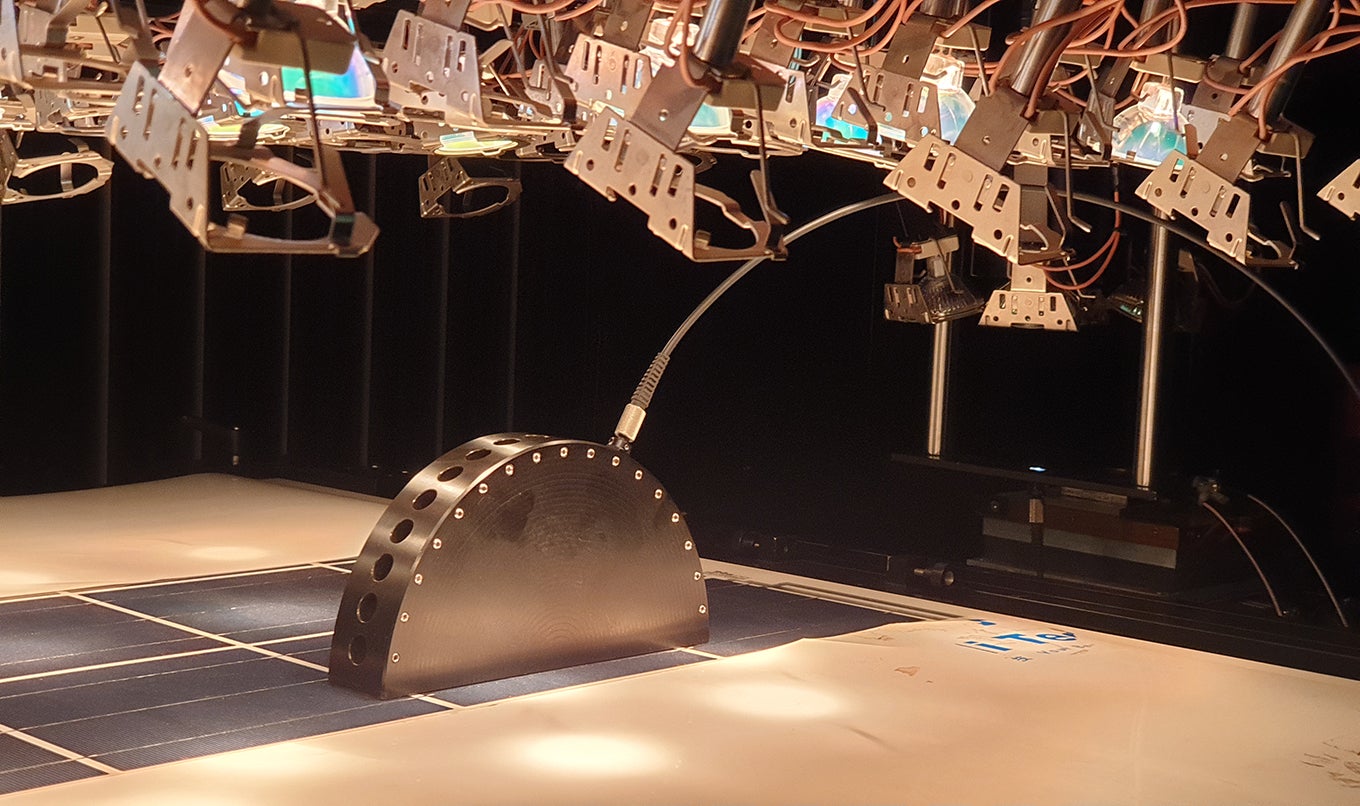

SERIS’ ISO/IEC 17025 accredited PV Module Laboratory started its testing operations in 2010. Located in CleanTech Park, it has regularly embarked on equipment upgrades and system updates to remain relevant to the changing needs of research centres and the solar industry. In addition to the standard testing, research activities such as on Potential Induced Degradation (PID), measurement of the Incident Angle Modifier (IAM), and reliability of modules for floating PV applications enable the Laboratory to address specific concerns of the PV industry. The Laboratory has ISO 17025 accreditation from the Singapore Accreditation Council (SAC) for PV module qualification and safety. It is also accredited for the electrical characterisation of secondary reference standards (“Golden modules”) according to IEC 60904-2, and for the classification of solar simulators according to Edition 3 of IEC 60904-9. The Laboratory offers, among others, the following tests to the industry and to research partners.
Golden modules (or “secondary reference standards”), temperature coefficients, and irradiance dependence.
Equipped with two Class A+A+A+ large-area pulsed solar simulators, the Laboratory can characterise all types of commercially available PV modules at Standard Test Conditions (STC), including bifacial and heterojunction modules. This is particularly important for PV module manufacturers who need a set of secondary reference standards (also referred to as “Golden modules”) to calibrate their own solar simulators on their production lines. In 2024, the laboratory has expanded its scope to cover bi-facial modules, measured according to IEC TS 60904-1-2 Edition 1.0, to meet increasing demands from the industry for measurements and characterisation of such modules.
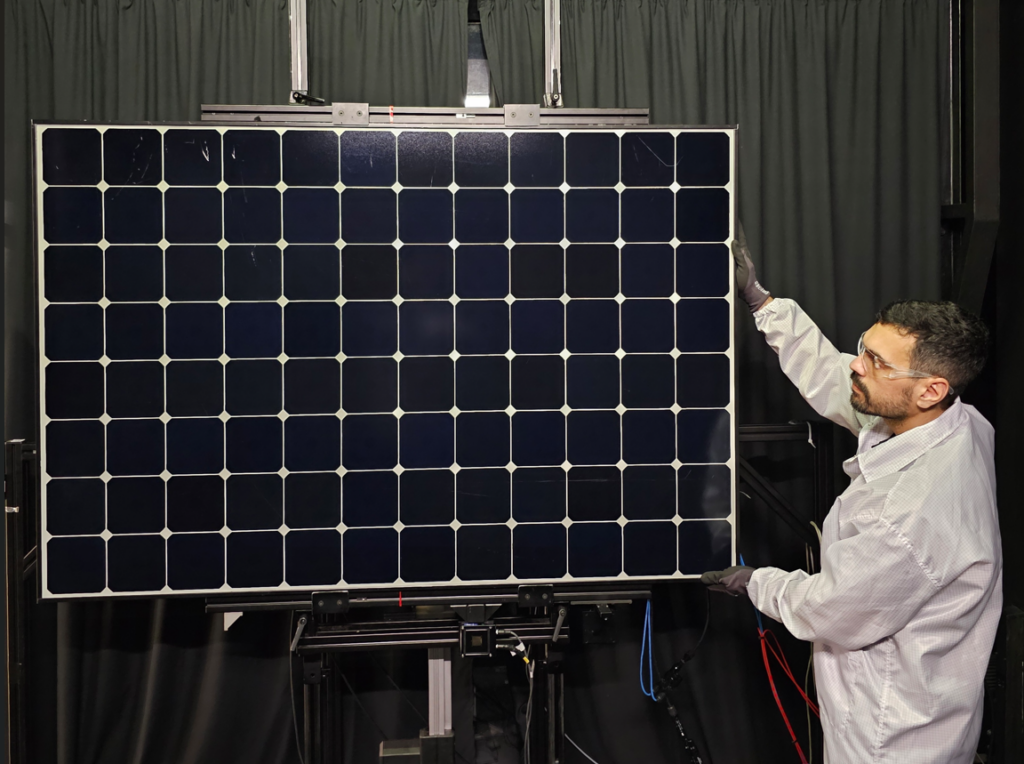
Electroluminescence (EL) and Photoluminescence (PL) of PV Modulesles
Reliability studies often require identifying the underlying causes of failures or performance degradation in photovoltaic (PV) modules. Electroluminescence (EL) is a well-established imaging technique used to detect issues such as microcracks, corrosion, or missing/ delaminated contacts. Interestingly, EL works in a manner that is essentially the reverse of normal PV cell operation: while a PV cell typically generates current when it absorbs light (light absorption generates current), in EL, an external current is injected into the cell, causing it to emit infrared (IR) light (current generates light emission in the Infrared). Areas with defects or interruptions in current flow show reduced IR emission, making these problems easy to spot.
Alongside EL, SERIS also conducts photoluminescence (PL) analysis. In PL, IR emission is produced by photon absorption under open-circuit conditions, using powerful LEDs to uniformly illuminate the module. Low-emission areas in PL images usually point to intrinsic cell defects rather than issues with current flow.
By applying both EL and PL imaging to the same module, it becomes possible to gain a more comprehensive understanding of the module’s quality and to better identify the root causes of power losses.
Incident Angle Modifier (IAM)
New PV module architectures, with increasing number of busbars, textured surfaces, smart-wire connections, IBC cells and shingling of cells, have raised the interest in the investigation of the angular responsivity of PV modules. Our laboratory has developed an advanced experimental setup specifically designed to measure IAM in full-size commercial PV modules. This approach enables a detailed analysis of how various module architectures affect angular responsivity. Notably, our measurement method has been included in the draft revision of IEC 61853-2, which is anticipated to be officially adopted in early 2026.